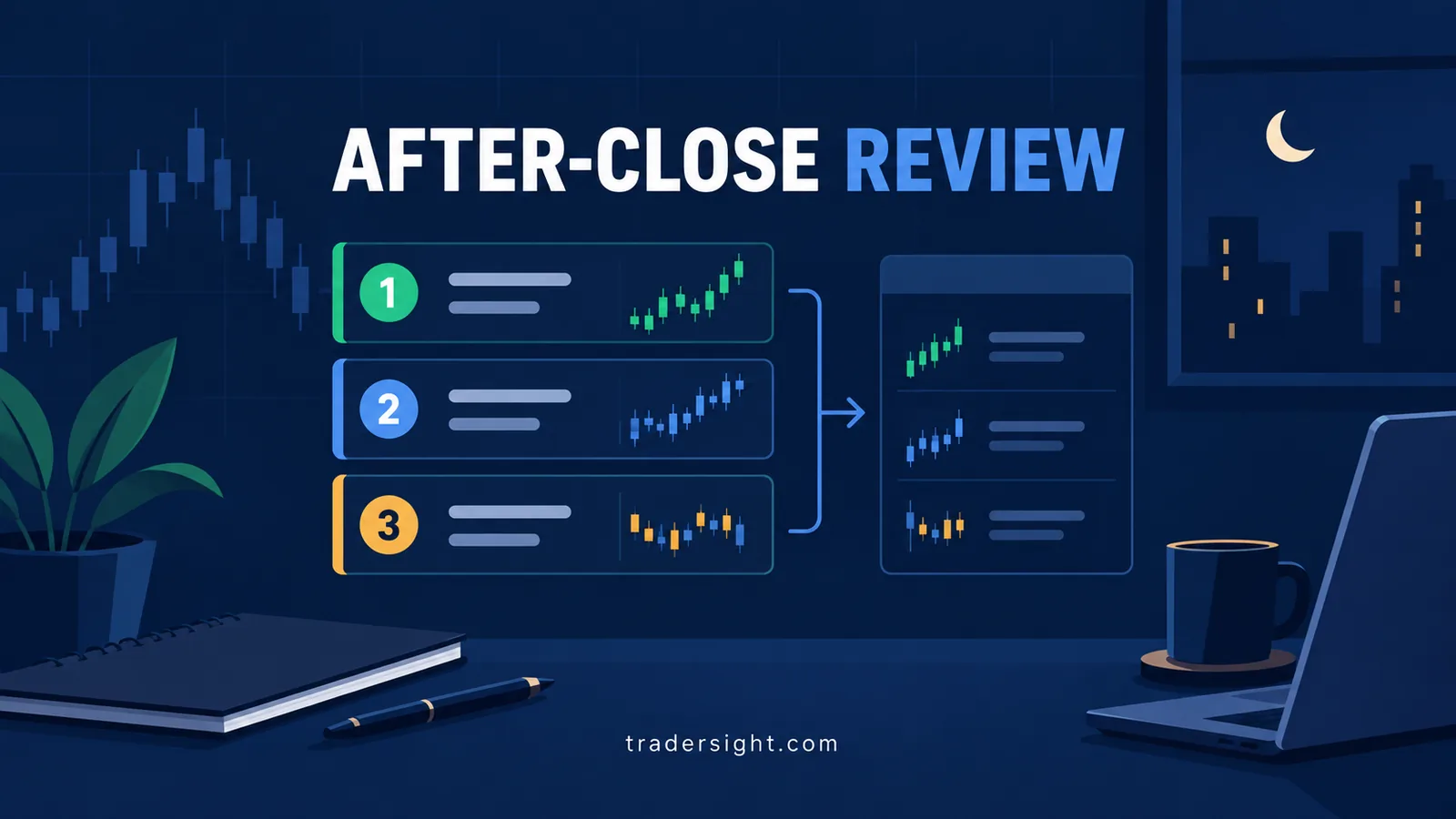
An after-close swing trading routine turns a completed market session into a short review queue. Its output is a documented watchlist: which setups still deserve attention, what changed, and what would make you remove them. The routine should be repeatable even when the symbols and market conditions change.
TraderSight’s end-of-day swing trading scanner organizes the first pass. This guide covers the review and recordkeeping process. If your main constraint is being unavailable during the next session, use the separate guide to swing trading with a full-time job for order instructions and execution planning.
Start the after-close routine with the session date
Check the trade date before interpreting a rank or state change. A completed daily bar gives you a consistent observation point; incomplete volume or a midday range does not represent the final session.
The app identifies the session behind its results. Free research is one session delayed, so the date you are reviewing can be earlier than the most recent close. Record that date in your notes rather than describing every result as tonight’s. The public Bullish Radar preview is illustrative, with example values rather than current market data.
Also check market context. The Bullish setup breadth page shows participation across that model’s lifecycle. It does not combine Bullish and Bearish states or provide an intraday signal.
Choose a radar before comparing candidates
Bullish and Bearish setups answer different research questions. The Bullish Radar follows contraction in an uptrend near prior highs; the Bearish Radar follows relatively weak common stocks consolidating near support.
Review each list independently. A Bullish score of 80 is not stronger or weaker than a Bearish score of 75, because the components and state rules differ. Keep separate notes if you review both directions. The scoring methodology explains the models; the remaining examples here use bullish long-stock setups only.
Review changes before adding more symbols
Begin with the names already on your watchlist. Ask what happened to the observation that put each one there:
- Did the daily range contract or widen?
- Did price move closer to the prior high or lose a required moving average?
- Did the state change, and does the chart explain why?
- Has an upcoming event changed the risk of keeping it on the list?
Then inspect newly matching candidates. A rank helps allocate attention, but an improving total should not replace the explanation behind it. Read the setup progression guide when you need to distinguish a useful change from a one-session fluctuation.
Check the chart behind the score
For a bullish candidate, compare the recent daily bars with the earlier base. Range contraction and volume dry-up are separate measurements; both need context. A large earnings bar in the baseline can make later sessions look unusually quiet.
Check whether the pullbacks are actually shrinking, whether the base sits near its prior high, and whether relative strength reflects steady performance or one large gap. Read the state reason even when the total looks attractive. A structure break can invalidate a setup while some components remain high.
Finally check earnings, news, and other scheduled events in your own sources. The radar does not supply a complete event calendar, and completed daily data cannot describe tomorrow’s opening gap.
Worked example: record a review decision
Consider a fictional stock after a completed close. It has a prior 252-session high of $80.00 and closes at $79.20, 1% below that level. Its latest 10-session average daily range is $1.20 versus $2.00 over the preceding 40 sessions, a ratio of 0.60. All four trend checks pass.
Assuming no earlier Breakout state or invalidation rule overrides it, those measurements meet the Bullish Ready checks. The useful review note is not “buy because it is Ready.” It is a short plan that another evening’s review can test:
| Review field | Illustrative note |
|---|---|
| Observation | Tight daily ranges near the prior high; confirm shrinking pullbacks on the chart |
| Possible trigger | $80.10, above the marked reference high |
| Invalidation level | $77.60, chosen from the chart for this hypothetical plan |
| Event check | Verify the next earnings date before placing any order |
| Next review | Keep only while the base and event conditions still fit the written plan |
With a hypothetical $50,000 account and a chosen 0.5% planned risk budget, the dollar budget is $250. A $2.50 entry-to-stop distance permits 100 shares before any position cap, commissions, or slippage. The stock position size calculator performs that calculation; the example is not a recommended risk level or an execution guarantee.
Keep the watchlist small enough to revisit
A watchlist is a queue for future decisions. Remove names when the original observation no longer holds, rather than keeping them because they once ranked well. Write the reason for removal: invalidated structure, excessive extension, an event conflict, or a better-defined alternative.
Avoid recording several highly correlated stocks as unrelated opportunities. A group of semiconductor setups may share one driver. The guide to how many stocks belong on a swing watchlist covers review capacity and concentration in more detail.
Common after-close review mistakes
- Using the wrong session. Delayed results can be useful research, but they need a fresh chart check before execution.
- Treating rank as a trade instruction. Scores prioritize chart review; they do not select your entry, risk, or position.
- Combining the two radars into one ranking. Compare candidates within their own model.
- Adding without pruning. A list that grows every evening eventually stops being reviewable.
- Repeating the screen without keeping notes. Without the prior observation, a daily change has little context.
Finish the after-close swing trading routine with a few notes you can read the next evening: session date, radar direction, chart observation, invalidation condition, and next review action. Use the weekly review routine to assess those decisions over time instead of rewriting the process after every session.
Create a free TraderSight account to review ranked setups and their explanations. Free results are one session delayed; see plans and trial eligibility for the latest completed-session research and broader coverage.
Put this review into practice
Review real daily charts with a setup score and an explanation of the current state. Browse ranked setups and look up additional stocks free, with results one session delayed.
Educational only. Not investment advice.