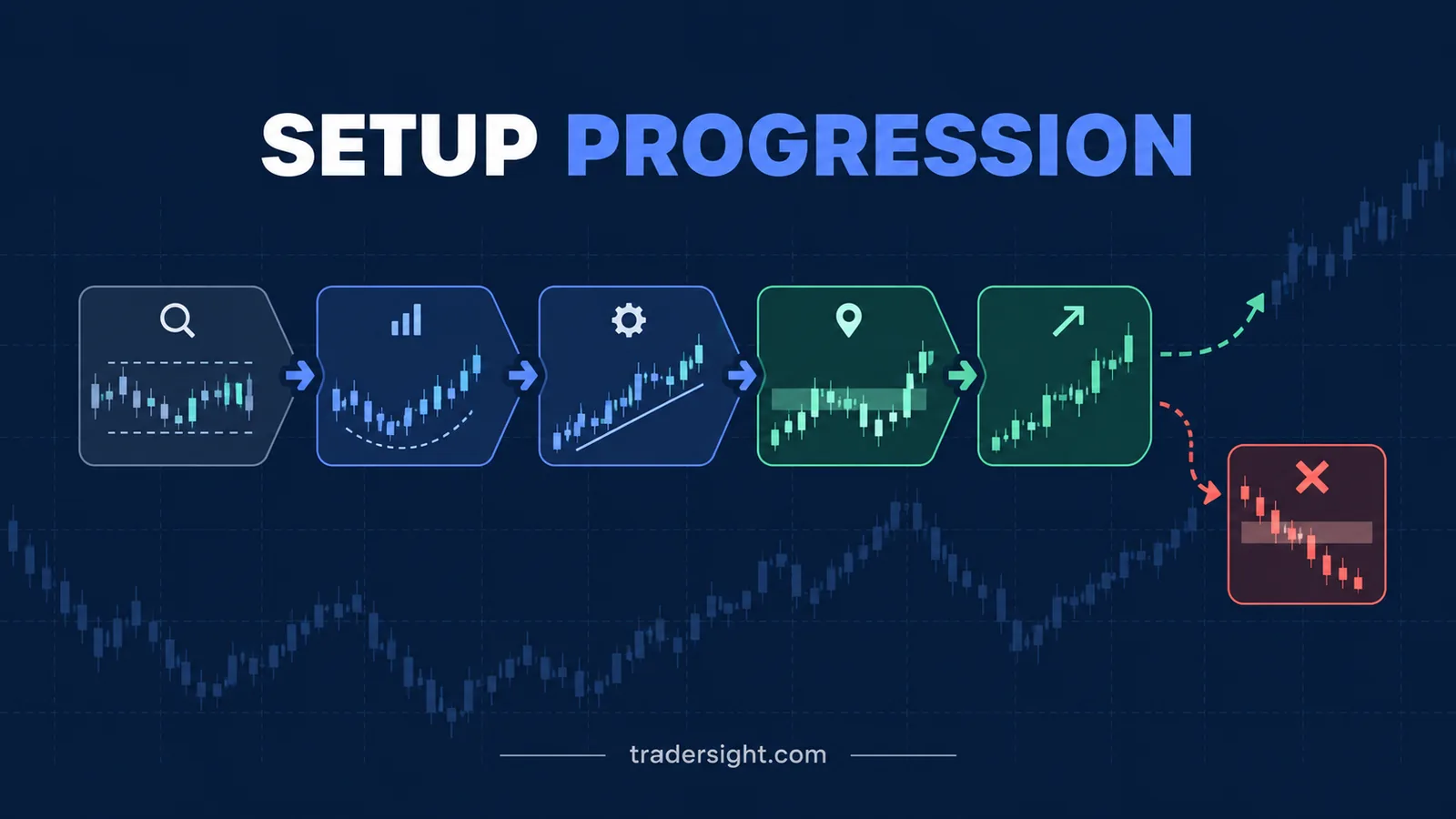
Swing trade setup progression describes how a chart changes from one completed session to the next. This guide follows the Bullish Radar: a candidate may tighten, approach its prior high, break out, become extended, or lose its qualifying structure. TraderSight’s separate Bearish lifecycle uses different states and rules, described in the methodology.
A static label can create false certainty. “Ready” does not mean a breakout will occur, and “breakout” does not mean the move will continue. Lifecycle states organize observations so a trader can review the right charts in a consistent order and notice when the original setup has changed.
The Bullish Radar uses six states: Developing, Tightening, Ready, Breakout, Extended, and Invalidated. They describe the current setup condition, rather than a recommendation, probability, or required path.
Why setup progression matters
Many watchlists mix early ideas, nearly complete structures, active breakouts, and stale names in one undifferentiated list. That makes it difficult to decide what needs attention tonight.
Lifecycle states create a review queue that separates early ideas, improving candidates, active breakouts, and setups that are now extended or invalidated.
This progression is especially useful in an after-close swing-trading routine, when completed daily data provides a consistent comparison point.
The six swing-trade setup lifecycle stages
Developing
A developing setup has enough constructive characteristics to remain under review, but important parts of the structure are incomplete. The trend may be constructive while price is still loose, or relative strength may be improving before the consolidation becomes orderly.
The appropriate research action is observation. Record why the candidate entered the radar and what evidence would show improvement or deterioration. “Developing” should prevent an early idea from being presented as complete.
Tightening
A tightening candidate is showing clearer contraction across recent sessions. Daily ranges may be narrowing, moving-average structure may be becoming more orderly, or volume behaviour may be improving.
Tightening does not mean every component must improve simultaneously. The detailed record should explain the mix. For example, price contraction might strengthen while relative performance stays flat. The guide to tight consolidation swing-trade setups explains those component relationships.
Ready
A ready setup has progressed close enough to its relevant reference area, with a sufficiently constructive component mix, to deserve priority in the next review. The label means “review closely,” not “enter a trade.”
Overnight information and next-session price action can immediately change the state. A gap, a wide reversal, missing data, or a violation of the required structure can make the prior close’s ready label stale.
Breakout
Breakout describes a setup that has moved through its defined recent reference area under the system’s observation rules. It records an event that occurred; it does not assert that the move is genuine, durable, or suitable for a particular trader.
A breakout state can later progress, become extended, fall back, or invalidate.
Extended
An extended candidate has moved far enough beyond the original developing structure that it should no longer be treated like a setup waiting near its reference area. This distinction helps prevent a ranking built from earlier constructive behaviour from obscuring the current price context.
Extended is not synonymous with “must fall,” nor is it an instruction to sell. It says the original setup-review question has changed.
Invalidated
An Invalidated setup fails a model rule, such as closing below its 50-day average, falling below the minimum trend score, or being detected as an acquisition pin. A prior Breakout or Extended setup also invalidates on a close below the 20-day average. Widening ranges or weaker relative strength alone do not automatically establish that state; read the actual reason.
Invalidation is valuable because it creates an explicit reason to remove or deprioritize a candidate. It does not mean the security can never form another setup. A new structure may develop later and should be evaluated on its own evidence.
Progression is not a straight line
The convenient diagram is:
| |
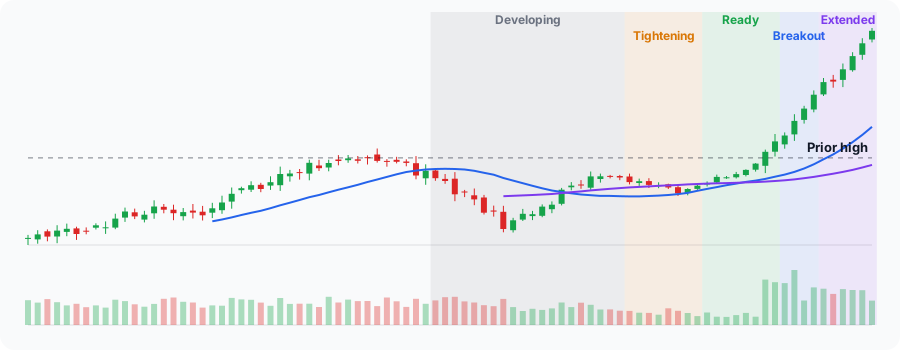
Real sequences can move backward, skip preparation states, or end early. A Tightening candidate can loosen and return to Developing. A Ready setup can invalidate without breaking out. A close above the prior high can move a candidate from Developing straight to Breakout without an intervening Ready close. Extended is evaluated on a later session after Breakout, using the model’s extension rule.
Worked example: a fictional five-session timeline
Consider Demo P, a fictional security observed over five completed sessions:
| Session | Score | State | Recorded change |
|---|---|---|---|
| Monday | 74 | Developing | Constructive trend, but recent ranges remain loose |
| Tuesday | 79 | Tightening | Range contracted and relative strength improved |
| Wednesday | 85 | Ready | Second tighter close near the reference high |
| Thursday | 89 | Breakout | Closed above the reference area with stronger volume behaviour |
| Friday | 76 | Extended | Moved well beyond the original consolidation; proximity context changed |
Nothing in Monday’s state guaranteed Thursday’s event. Each label was assigned after new data arrived. If Thursday had instead closed below a required trend level, the Friday row might have read “Invalidated.”
The score also did not need to rise forever. Friday’s lower score does not declare the move unsuccessful. It reflects that the current chart no longer resembles the developing setup the system was designed to rank.
What to document each night
State labels do not supply a personal share count. Once you have chosen a chart-based entry and stop, use the stock position size calculator to translate your own risk budget into shares.
For each watched candidate, record four items:
- Current state: Where does the setup sit now?
- Material change: What improved, weakened, triggered, or broke since the prior session?
- Supporting components: Which score categories explain that change?
- Review condition: What observable development would keep or remove the candidate from tomorrow’s list?
This note can be short. “Tightening for a second session; volume behaviour improved; remove if trend condition fails” is more useful than copying an unexplained score into a spreadsheet.
TraderSight provides a daily change explanation alongside component values and lifecycle history in the authenticated application. The ranking methodology explains what the score does and does not represent.
Avoid turning states into signals
Lifecycle labels organize research, but they do not know your financial situation, risk tolerance, existing exposure, holding period, or decision rules. They also cannot remove overnight gaps, event risk, data limitations, or false breakouts.
Avoid statements such as:
- “Ready means buy tomorrow.”
- “Breakout means the trade will work.”
- “Invalidated means the security will decline.”
- “A score of 90 means a 90% success rate.”
Each claim adds predictive meaning that the state and score do not contain.
Use lifecycle states to keep a watchlist current
The practical benefit of swing-trade setup progression is attention management. Developing and tightening candidates remain visible without being overstated. Ready candidates receive focused review. Breakout and extended names are separated from pre-breakout structures. Invalidated names can leave the active queue with a documented reason.
Repeat that classification after each completed session and the watchlist becomes a record of changing evidence rather than a collection of stale tickers. That is the connection between progression and TraderSight’s broader goal: a concise nightly review that explains what changed since yesterday.
See all six states in the illustrative TraderSight radar, then review the Standard plan for access to authenticated rankings, watchlists, lifecycle history, and the daily digest.
Put this review into practice
Review real daily charts with a setup score and an explanation of the current state. Browse ranked setups and look up additional stocks free, with results one session delayed.
Educational only. Not investment advice.